
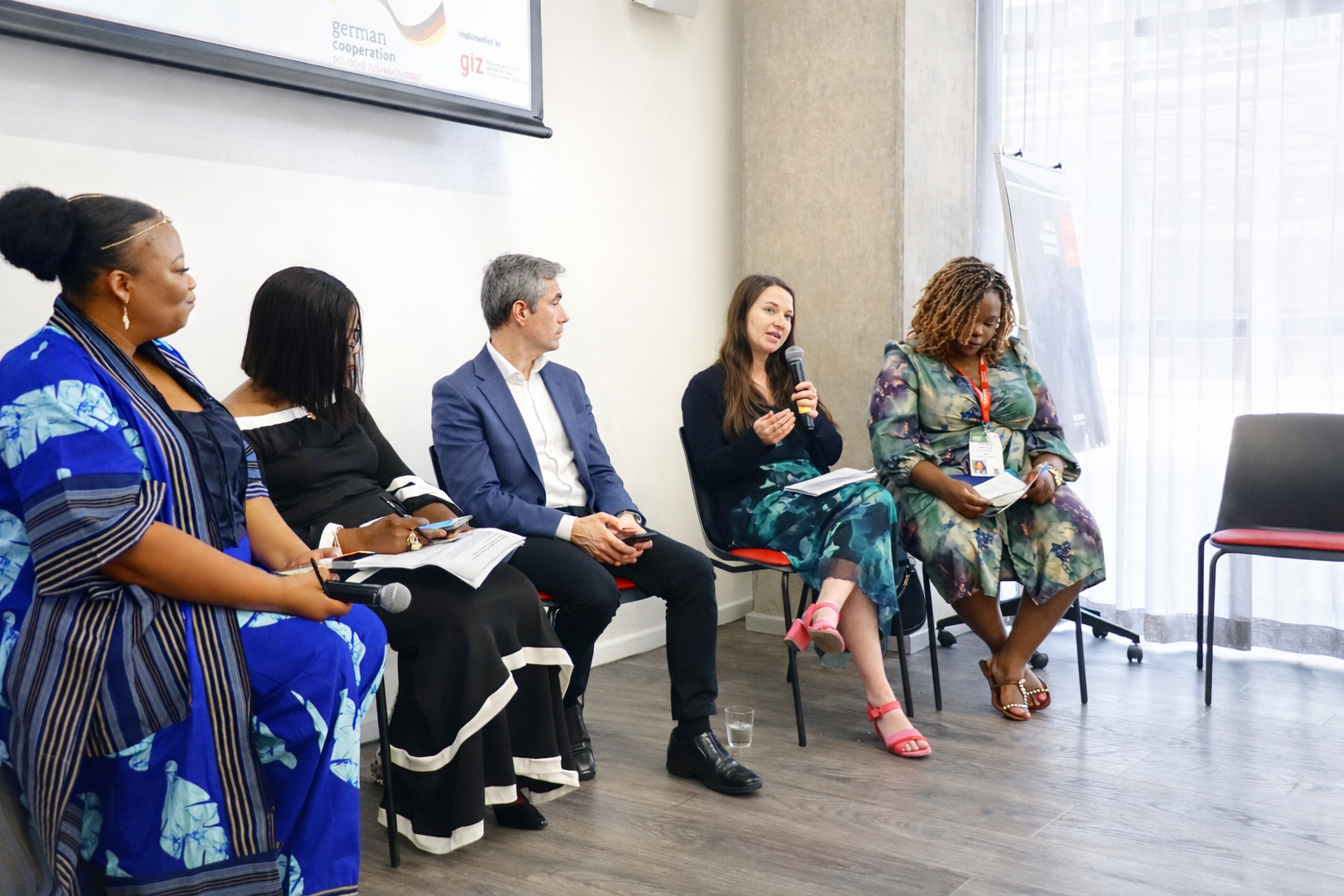
From left to right: Zenzi Awases (moderator), Janet Adeyemi, Clovis Freire, Mayely Müller and Nyaradzo Mutonhori ©GIZ.
As part of the GIZ Side Event Day (12.02.2026) held alongside the Mining Indaba in Cape Town, the session “Unearthing Markets: Trade Access for Women in Africa’s Mining Sector” explored how trade frameworks, market initiatives, and responsible sourcing standards can strengthen women’s access to mineral markets. The session was convened by the Women’s Rights and Mining Group (WRM), hosted by GIZ and the Secretariat of the Intergovernmental Forum on Mining, Minerals, Metals and Sustainable Development (IGF).
The session was moderated by Zenzi Awases, President of the Association of Women in Mining in Africa (AWIMA) and Chairperson of the Women in Mining Association of Namibia (WiMAN). Panellists included Clovis Freire, Chief of the Extractive Commodities Section, Commodities Branch, UNCTAD; Mayely Mueller, Senior Advisor at the European Partnership for Responsible Minerals (EPRM); Nyaradzo Mutonhori, Program Lead for Zimbabwe at IMPACT under the planetGOLD project; and Janet Adeyemi, Founder and National President of Women in Mining Nigeria.
The discussion highlighted that women in mining and mineral value chains often face major barriers in reaching buyers directly. Many remain dependent on intermediaries, which weakens their bargaining power and limits income opportunities. At the same time, certification, compliance, and due diligence requirements are often too costly or complex for women-led small businesses and women in artisanal and small-scale mining (ASM).
Participants emphasized that frameworks such as the African Continental Free Trade Area (AfCFTA) offer real potential, but only if implementation is backed by practical support. This includes better access to market information, export facilitation, infrastructure, and tailored measures for women-led actors. Formalization was also identified as a key pathway to opportunity, especially when women are supported through cooperatives and associations that can improve access to finance, safety, and direct buyer relationships.
Another key message was that responsible sourcing and gender-responsive due diligence must be implemented in ways that support, rather than exclude, women producers. Long-term engagement across supply chains is essential, as is stronger alignment between standards and local realities. At the same time, greater value addition—through skills development, technology, certification, and branding—can help women move into higher-value segments of mineral markets.
Overall, the session made clear that improving women’s market access requires more than visibility. It requires practical pathways to buyers, targeted support, and inclusive trade and sourcing systems that enable women to participate fully in Africa’s mining sector.
This also underlined the importance of the Women’s Rights and Mining Group (WRM) as a platform for connecting stakeholders, amplifying women’s voices, and driving more inclusive approaches across the mining sector.


